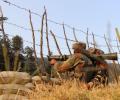
'India has to understand that the permanent state of war that exists between India and Pakistan has to be expected,,' says Colonel Anil A Athale (retd). 'The only way to ensure peace or absence of war is to maintain a militarily-dominant position over Pakistan.'

'As Mumbai showed, and the Nairobi Westgate Mall attack reinforced, "guerrilla-style terrorism" has increasingly become the method-of-choice for terrorist groups,' says terrorism expert David Kilcullen.

If the radical Islamic movement had been largely peaceful, Headley would have probably found another way to ensure real life excitement.' 'But I really do believe that his relationship with radical Islam is real. Very real.' 'It was a match for his desires.'

'An operation such as the Mumbai attacks, which needed expert technical assessment, money and time to prepare, could not have been carried out without the knowledge of the ISI's leadership.'

'The interests of the United States and India are sharply aligned on the issue of Pakistan-based terrorism.'

The joint statement issued after Prime Minister Narendra Modi and President Barack Obama's first-ever summit is high on intent and ambition. Notably missing from the statement is India's refusal to be America's partner in its war against ISIS.

'Imagine for a moment that the Coast Guard was unable to stop the vessel and it reached Porbandar with its cargo/personnel and targeted the event at which the prime minister was present,' says Colonel Anil A Athale (retd).

Saroj Kumar Rath, author of the newly-published book Fragile Frontiers: The Secret History of Mumbai Terror Attacks, speaks to Rediff.com's Vicky Nanjappa.

'We're going to see a defence relationship that really takes off -- now that India is a major defence partner of the US, the sky is the limit for arms sales.' 'The economic partnership will lag behind the security relationship, but the meeting and joint statement give cause to believe that it will progress more robustly than many of us would have expected.'

'Diplomatic engagement will continue even as India keeps all its options open with respect to discretely targeting the Pakistani military and its terrorist proxies.'

How to deal with a country that has made export of terror a reason to make the world notice and fund it? Rediff.com contributor Sanjeev Nayyar offers a few suggestions

'For a long time Pakistan dreamt that India would break up and that it would be the predominant power in the region,' says Colonel Anil A Athale (retd).

'Pakistan is convinced that the Modi government has -- given its image and political compulsions -- no choice but to act in the case of another terror attack.'
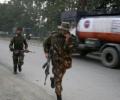
'No amount of economic measures or prosperity in Kashmir will make any dent in the situation there. The average Kashmiri understands the Pakistani game and is unlikely to prefer Pakistan over India. But the Pakistanis have made clever use of religious symbols and slogans to force religious-minded Kashmiris to support them. India has failed to counter this posturing by the separatists,' says Colonel Anil A Athale (retd).

After weighing all the costs and benefits, the next administration is likely to reduce and restructure assistance to Pakistan but not to end it altogether, says Daniel S Markey.

'Omar Khorsani has called repeatedly for the most barbaric of attacks. He is very adept on social media. He is, in other words, eerily similar to the ISIS leader Baghdadi.' 'The crux of the army's 'strategic asset' policy -- its policy of regarding militants as those that can help Pakistan pursue its regional interests -- is that Pakistan needs help in weakening India or in keeping its presence minimal in the region.' Michael Kugelman reveals what the world can expect next from the Tehreek-e-Taliban Pakistan, the terrorists responsible for the Peshawar school massacre.

'Checkmating India by its nukes, Pakistan can pursue terrorism against India in the Kashmir Valley and also resume launching Mumbai 2008 style attacks.' 'The military oligarchy in Pakistan has a totally different view of what is desirable and possible in the subcontinent.'

Rediff.com reproduces this 2014 interview with Tim Kaine where in he discusses the new opportunities to foster Indo-US trade and the improvement in ties.

The developments in Af-Pak region, particularly the fall out of Pak political paralysis, would make President Xi Jinping's task a little more complicated, says Colonel R Hariharan.
.jpg)
It's perverse to rationalise 'controlled' killings or torture -- without going down a slippery moral slope. Once the state stoops to torture, it's liable to sink into tyranny, says Praful Bidwai.

A new report says Indian jihadis, including the Indian Mujahideen, are significantly more lethal as a result of external support, primarily from Pakistan. Aziz Haniffa reports.

Ajit Doval, former chief of Intelligence Bureau and now head of Vivekanada International Foundation, continues his furious argument against any kind of CBI action against his former colleague Rajinder Kumar in the Ishrat Jahan fake encounter case of 2004.

'It is in the interest of both sides that the visit of the US President is seen as being successful. Both sides have invested considerable political capital in it. This rapid exchange of visits and the decisions taken have to be justified, beyond the symbolism, which is no doubt important in itself. This opportunity to impart a fresh momentum to ties should not be missed,' says former foreign secretary Kanwal Sibal.
 © 2026 Rediff.com - Advertise with us - Disclaimer - Privacy Policy - Sitemap - Feedback - About us - Terms of use - Grievances